
Paxos Upgrades Order Routing to Power the Next Generation of Crypto Brokerage


The Execution Gap in Institutional Crypto
When the first wave of fintechs and neobanks began offering crypto trading, the model was straightforward: connect to an exchange, execute against a single order book and pass the fill back to the client. For retail-sized orders on liquid pairs, that was good enough.
It's not good enough anymore.
Paxos already powers crypto trading for some of the largest financial platforms in the world. In our conversations with broker-dealers, banks, wealth platforms and fintechs racing to offer crypto under their own brands, we hear the same thing: they need to fill larger tickets without moving the market, demonstrate best execution to regulators, not just claim it, and maintain a complete, auditable record of every routing decision. And they need all of this without the operational overhead of stitching together bilateral connections with a half-dozen venues and liquidity providers.
Yet most crypto infrastructure still treats execution as a commodity, a pipe that moves orders from point A to point B, with little attention to whether the client actually got the best available price. In traditional markets, best execution is a well-established obligation with decades of infrastructure behind it. Crypto is still catching up.
We believe the standard should be the same. Today, we're rolling out upgraded order routing capabilities for the Paxos Crypto Brokerage platform. Starting now, every order that flows through Paxos benefits from multi-venue smart routing by default. This means accessing deeper liquidity, achieving better blended pricing, and generating a complete audit trail, all through the same single integration our partners already use.
Here's what that looks like under the hood.
Smarter Routing, Better Prices
Execution quality starts with how orders are routed. In equities and fixed income, this is well understood: routing logic, venue selection and fill analysis are core competencies, not afterthoughts. We built our order routing engine with that same standard in mind. It's purpose-built for the partners we serve: broker-dealers, banks, wealth platforms and fintechs that need institutional-grade execution without building the infrastructure themselves. It sits between your client order flow and the venues you trade on, continuously evaluating pricing and liquidity across multiple sources and routing intelligently to deliver stronger, more consistent results.
Rather than sending an entire order to a single venue, the router can slice it into smaller child orders and distribute them across venues and price levels. Thus, pursuing a better blended price for the parent order, within your configured risk limits and routing preferences.
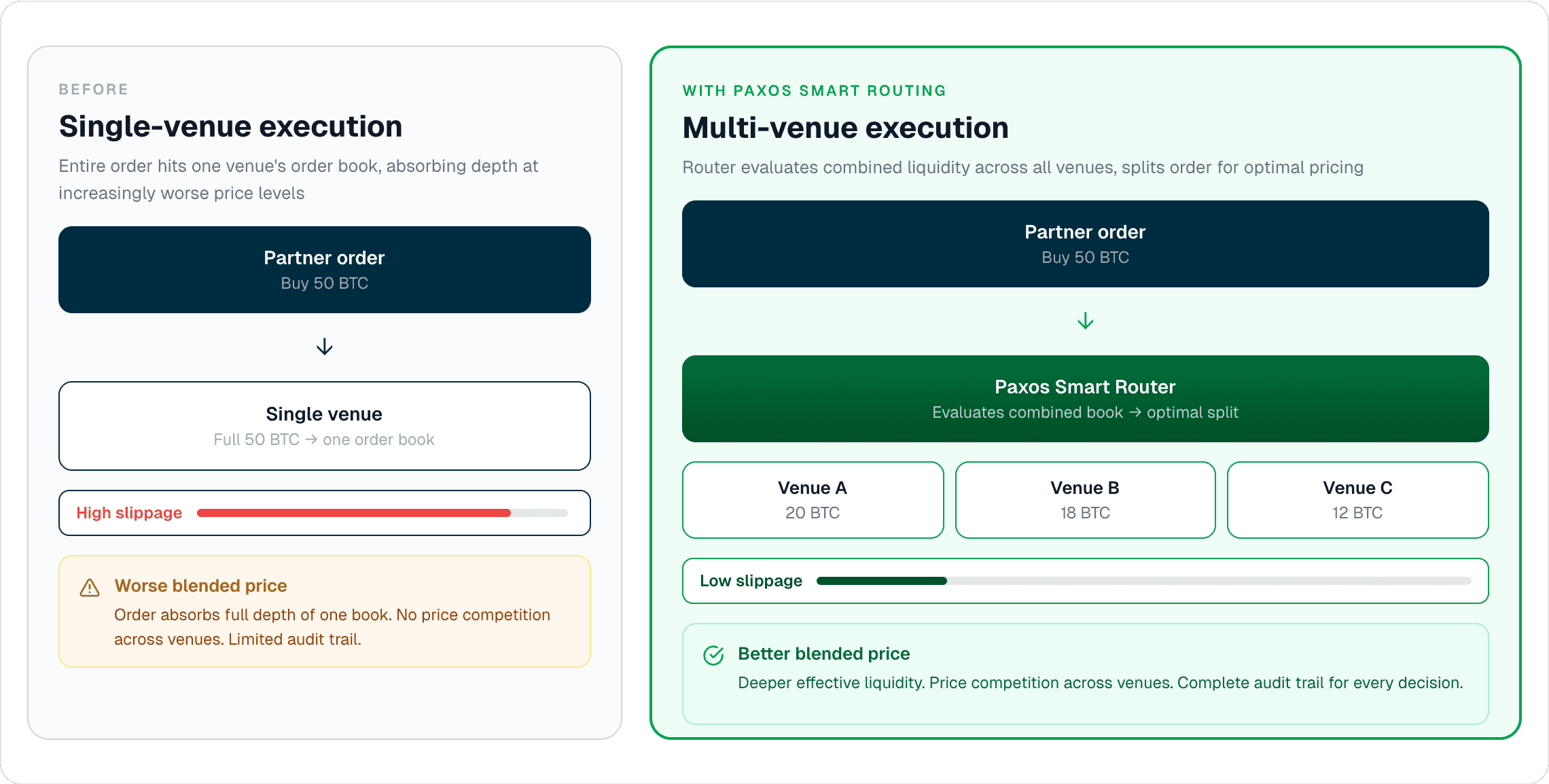
Consider a partner executing a large BTC order during a volatile session. Instead of hitting a single venue's order book and absorbing the available depth at increasingly worse price levels, the router evaluates the combined book across all connected venues, determines the optimal split, and executes a sequence of child orders designed to minimize slippage. The partner sees a single parent order with a better blended fill. Their compliance team sees a complete record of every decision the router made and why.
A Growing Liquidity Network
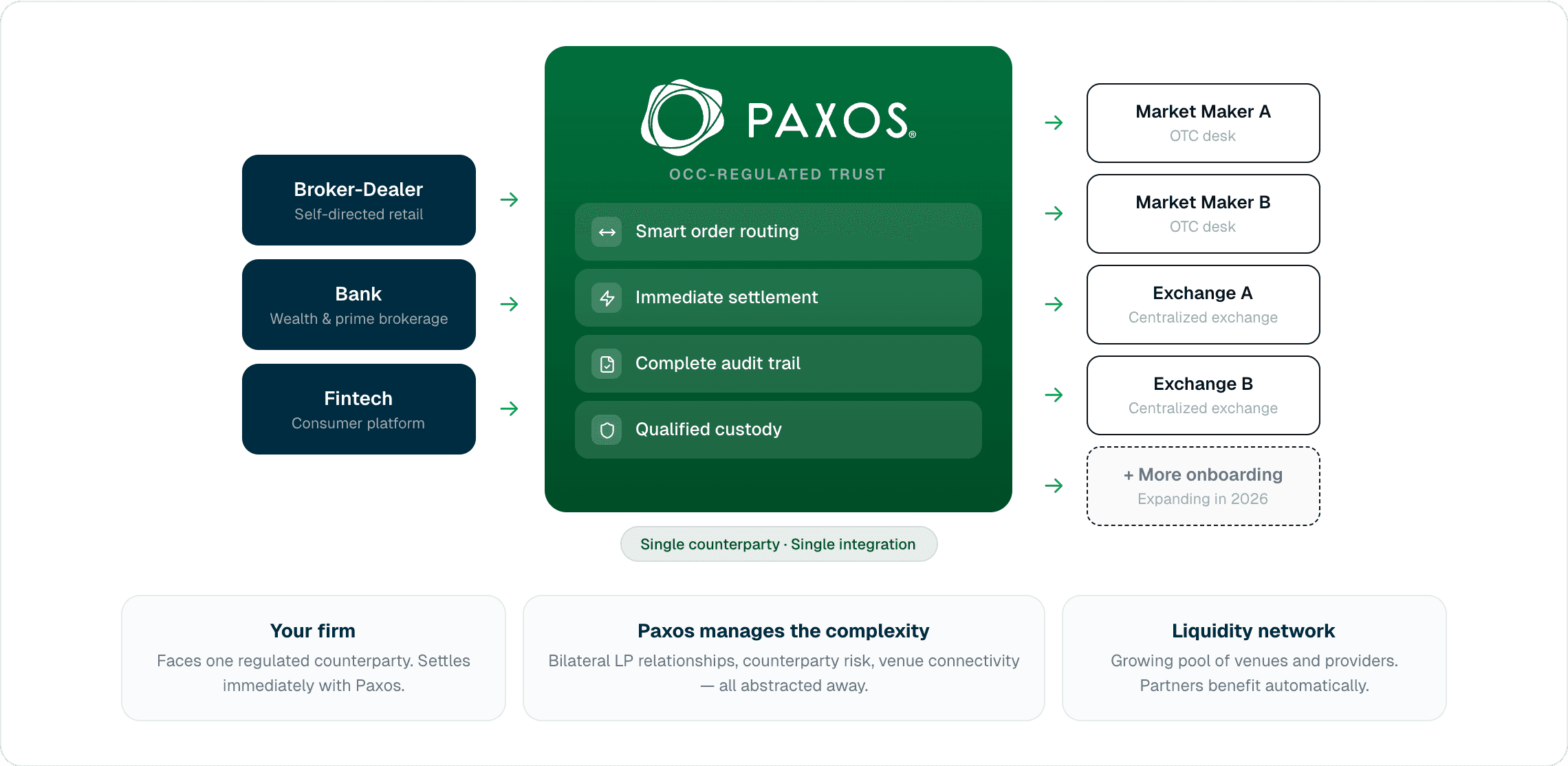
The router is only as good as the liquidity behind it. Paxos' order routing now aggregates pricing from the Paxos exchange, an expanding set of external liquidity partners, with additional centralized exchanges and execution venues coming online throughout 2026. In practice, that means your orders can tap into quotes from leading market makers and OTC desks, with more partners in active onboarding.
As we add new liquidity providers, they join the same virtual, multi-venue order book that powers all routing decisions. Partners gain access to a growing pool of liquidity through a single integration — without the overhead of standing up and maintaining dozens of bilateral connections themselves.
Because Paxos focuses on infrastructure, we don't operate a consumer exchange or compete for your end customers, every liquidity relationship and routing optimization is built to serve our partners' execution quality, not our own trading book. And partners trade with Paxos directly, not with the underlying liquidity providers. We handle the bilateral relationships and counterparty complexity, so your firm settles against a single, OCC-regulated entity no matter how many sources the router taps.
Compliance By Design, Not an Afterthought
For institutions operating under best-execution obligations, whether a broker-dealer filing with FINRA or a bank answering to the OCC, execution quality is only half the story. The other half is proving it.
Regulators expect firms to document, at the order level, what the market looked like when a trade was placed, what routing decision was made, and what the outcome was relative to the arrival price. Producing that evidence after the fact (e.g., by stitching together logs from multiple systems) is fragile, expensive and increasingly insufficient.
Our routing stack captures this from the start. Every routing decision and state transition is written to an append-only event log, giving you a complete, timestamped record of exactly what the router did on any given order, at any time. And over time, we're building toward giving partners the tools to systematically measure execution quality across their order flow.
The audit trail is stronger when the infrastructure behind it is held to the same regulatory standard as the institutions it serves. And because the routing engine is monitored around the clock, with 24/7 coverage across order health, venue status and system performance, issues are surfaced before they reach your clients.
Powering What Comes Next
Order routing is one layer of the broader Paxos Crypto Brokerage platform, which combines qualified custody, trading, settlement and, soon, yield products like staking through a single integration. The routing upgrade we're announcing today makes that trading layer significantly stronger, but what I'm most excited about is that it's connected to everything else: the same integration that routes your orders also handles custody, compliance reporting and settlement.
As we add new liquidity providers, list additional tokens on the platform, and connect to more execution venues globally, the router is the layer that ties it all together. Because new assets and venues integrate behind the same routing interface and virtual order book, partners benefit automatically — new markets become available without additional integration work. The same smart routing logic, best-execution controls and auditability simply extend to a broader universe.
This is also where our recent acquisition of Fordefi, an institutional-grade MPC wallet and Web3 gateway, fits in. Fordefi accelerates our ability to scale across new chains, which means we can onboard new assets faster and expand coverage for partners at a pace that matches demand. As we deepen the integration, it will unlock additional capabilities that we'll share more about soon.
Get Started
Whether you're a broker-dealer launching crypto for retail clients, a bank exploring digital assets across wealth and prime brokerage, or a fintech scaling an existing integration, we'd like to show you what upgraded routing can do for your execution quality. Reach out to your Paxos account team or contact us here.
This is the first in a series of posts about how we're building institutional-grade brokerage infrastructure for the next wave of crypto adoption. Next up: Why best execution in crypto deserves the same rigor it gets in traditional markets, and how we're giving partners the tools to prove it.
Related Posts
Best Execution in Crypto: It's Time to Raise the Bar
